


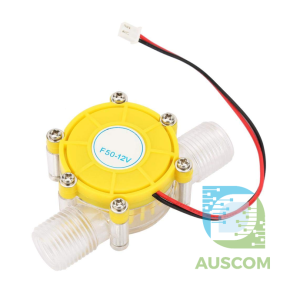
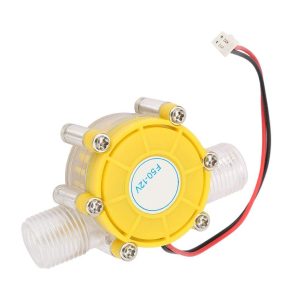


DC 5V 12V Micro Hydro Generator 10W G1/2″ Water Turbine DIY Power
$45.50 Inc. GST
You save
- Description
- Code Examples
- Additional information
- Reviews (0)
Description
💧 DC 5V / 12V Micro Hydro Generator 10W – G1/2″ Water Turbine | AuscomTech
The DC Micro Hydro Generator is a compact water-powered turbine designed to convert flowing water into usable electrical energy. With a standard G1/2″ male thread, it integrates easily into household plumbing, irrigation lines, or DIY water systems, making it ideal for small-scale renewable energy and educational projects.
Using water pressure alone, this turbine generates DC 5V or 12V output (pressure-dependent) to power LEDs, charge batteries, or supply low-power electronics without fuel, batteries, or external power sources.
⭐ Key Features
🔋 Renewable Energy Generation
Converts flowing water into electrical power with no fuel, batteries, or emissions.
🔌 Dual Voltage Output (5V / 12V DC)
Voltage output varies with water pressure, suitable for LEDs, charging circuits, and low-power devices.
🔩 Standard G1/2″ Plumbing Thread
Male G1/2″ thread fits common 1/2″ household water fittings for simple installation.
🔇 Low Noise Operation
Quiet turbine design with operating noise ≤55dB, suitable for indoor or enclosed systems.
🧪 Transparent Housing
Durable plastic casing allows visual inspection of turbine operation and water flow.
⚙️ Compact & Efficient Design
Small footprint makes it ideal for tight installations and DIY energy recovery systems.
📊 Technical Specifications
| Specification | Details |
|---|---|
| Rated Power | 10W |
| Output Voltage | DC 5V / 12V (pressure dependent) |
| Max Output Current | ≥220 mA |
| Starting Water Pressure | ≥0.05 MPa |
| Operating Pressure | 0.05 – 1.2 MPa |
| Line Resistance | 10.5 Ω ±0.5 Ω |
| Insulation Resistance | ≥10 MΩ (DC 100V) |
| Noise Level | ≤55 dB |
| Thread Type | G1/2″ Male |
| Material | Transparent Plastic |
| Colour | Transparent / Yellow |
| Dimensions | 8.8 × 5.8 × 3.9 cm |
⚠️ Note: Output voltage is proportional to water pressure. No voltage regulation is included.
🧩 Compatible With
• LED lighting circuits
• Battery charging modules
• Low-power DC electronics
• Microcontrollers (with regulation)
• Renewable energy demonstration systems
• DIY water flow projects
⚙️ Typical Applications
• Household water energy recovery
• Off-grid & eco-energy experiments
• Renewable energy education
• Science & engineering projects
• DIY hydropower systems
• Garden irrigation flow generation
• Environmental demonstrations
📦 Package Includes
• 1 × DC 5V / 12V 10W Micro Hydro Generator (G1/2″)
📌 Code Examples & Monitoring – Micro Hydro Generator (5 V/12 V, 10 W)
⚠ Safety First — Why Extra Hardware Is Required
This turbine produces raw DC with no regulation or protection.
Before connecting to any microcontroller, you must use a voltage conditioning circuit:
Recommended external modules:
-
DC-DC buck/boost regulator (to stabilize output to a known voltage)
-
Schottky diode (to prevent reverse current into the generator)
-
Large electrolytic capacitor (470–2200 µF) to smooth output ripple
-
Blocking diode + charge controller if charging batteries
-
Current/voltage sensor module (e.g., INA219 / ACS758 / ACS712)
⚠ Never connect the turbine output directly to a microcontroller pin — you risk damage.
📌 Typical Conditioned Power Setup
📊 What You Can Measure
✔ Voltage – how much the generator is producing
✔ Current – how much is being drawn
✔ Power (W) – voltage × current
✔ Energy generated over time (Wh)
All these are valuable for logging, displays, or IoT dashboards.
🧪 Arduino Example — Measure Voltage (Using a Sensor)
Assumptions:
-
You’re using a voltage sensor (e.g., simple voltage divider or INA219)
-
The regulated output is within the MCU safe range (0–5 V for Arduino)
Simple Voltage Divider Version
⚠ Only measure voltage after regulation and protection circuitry.
📈 Arduino Example — Measure Power (Using INA219)
Using a current + voltage sensor (e.g., INA219) makes real power measurement easy.
This example assumes you’ve placed the INA219 between the hydro turbine’s regulated output and your load.
📊 ESP32 Example — Log Power Values
Use the example above with ESP32 to send data over Wi-Fi / BLE.
🧠 Tips & Notes
⚡ Regulate the Output
-
Use a buck converter to keep voltage safe and stable
-
If charging batteries, use a charge controller module to prevent over/under-charge
🛡 Protect the Electronics
-
Add over-voltage protection
-
Add reverse current diode
-
Add capacitive smoothing to reduce noise
📊 Sampling Strategy
AC you measure from a generator isn’t perfect DC — sampling frequently (100–500 Hz) yields more accurate logged values.
💾 Data Logging
Pair with SD card module or cloud upload to store long-term power production data.
🧰 Example Use Cases
✔ Off-grid sensor power
✔ Small battery charging station
✔ Remote water flow monitoring + logging
✔ IoT dashboards with renewable energy stats
Additional information
| Weight | 100 g |
|---|---|
| Dimensions | 260 × 160 × 50 mm |
| Voltage | 5V, 12V |
Only logged in customers who have purchased this product may leave a review.


Reviews
There are no reviews yet.