


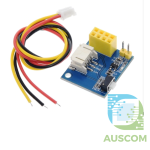
NodeMCU Motor Shield Board L293D ESP-12E ESP8266 WiFi Module Expansion

$10.30 Inc. GST
You save
- Description
- Code Examples
- Additional information
- Reviews (0)
Description
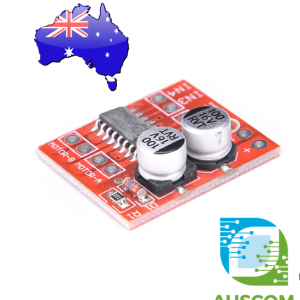
Upgrade your projects with the NodeMCU Motor Shield Board L293D, designed to seamlessly integrate the power of the ESP-12E ESP8266 WiFi module. This expansion board empowers your creations with motor control capabilities and WiFi connectivity, taking your innovations to new heights.
Key Features:
- Versatile Power Supply: The board supports motor power supply (VM) ranging from 4.5V to 36V, and control power (VIN) from 4.5V to 9V (10V max), offering the flexibility to power them separately.
- Simplified Circuitry: With a built-in short-circuit option (short VM and VIN), you can streamline your power supply to a single source (within the range of 4.5V to 9V), efficiently managing motor drive and control simultaneously.
- Efficient Power Management: The logic operating current (Iss) remains within ≤60mA (Vi = L) and ≤22mA (Vi = H), optimizing energy consumption.
- Robust Motor Drive: Drive work current (Io) stays below or equal to 1.2A, ensuring smooth and reliable motor operations.
- Effective Heat Dissipation: The module boasts a maximum power dissipation of 4W at a temperature of 90°C, maintaining performance even under demanding conditions.
- Precise Control Signals: Input level for control signals ensures accurate operation – High: 2.3V≤VIH≤VIN, Low: -0.3V≤VIL≤1.5V.
- Wide Temperature Range: Operating seamlessly between -25°C and +125°C, the board remains functional in various environments.
- Dual High-Power H-Bridge Driver: Drive Type supports two-way motor control, offering superior control over your motor-driven projects.
- Convenient Dev Kit Integration: Designed for ESP12E Dev Kit, the control ports (D1, D3 for Motor A; D2, D4 for Motor B) simplify the integration of your motor control and WiFi projects.
- Streamlined Design: Equipped with an onboard power switch, the module efficiently separates motor power from control power, enhancing your experimental setups.
- User-Friendly Notice: Ensure the correct insertion of the ESP-12E module, aligning its direction with the expansion board antenna for optimal performance.
- Seamless Compatibility: Utilize short modules to control both the board and motor simultaneously, creating a seamless integration.
Package Includes:
Elevate your projects with the L293D Wifi Motor Drive Shield Module. Unleash the potential of your Arduino NodeMcu Lua ESP-12E ESP8266 with motor control capabilities that revolutionize the way you innovate.
Explore the limitless possibilities of your projects today. Order your L293D Wifi Motor Drive Shield Module and transform your creations into wonders of technology and connectivity.
📌 Code Examples & Usage – NodeMCU Motor Shield (L293D, ESP8266)
📋 Overview
The NodeMCU Motor Shield is based on the L293D dual H-bridge motor driver, designed specifically to plug directly onto ESP8266 NodeMCU (ESP-12E) development boards.
It allows control of:
-
2 DC motors, or
-
1 stepper motor
Ideal for:
-
Wi-Fi controlled robots
-
Smart cars
-
Small automation projects
-
Educational motor control experiments
⚙ Key Features
-
Motor driver IC: L293D
-
Supports 2 DC motors or 1 stepper
-
Motor supply: 4.5V – 12V
-
Logic supply: 3.3V (from NodeMCU)
-
Direction + PWM speed control
-
Stackable design for NodeMCU ESP8266
⚠ IMPORTANT – Power Notes (READ FIRST)
🚨 Motors must NOT be powered from the ESP8266 5V/USB rail
✔ Motors require a separate external motor power supply
✔ ESP8266 is powered via USB or VIN
✔ Grounds must be common
Typical setup:
-
USB → NodeMCU (logic + Wi-Fi)
-
External battery / PSU → motor terminals
🔌 Motor Shield Connections
Motor Outputs
| Terminal | Function |
|---|---|
| M1+ / M1- | Motor 1 |
| M2+ / M2- | Motor 2 |
| VMOT / VIN | Motor supply (4.5–12V) |
| GND | Common ground |
🔌 ESP8266 GPIO Mapping (Typical)
Most NodeMCU motor shields use the following default pin mapping:
| Function | ESP8266 GPIO |
|---|---|
| Motor A IN1 | GPIO5 (D1) |
| Motor A IN2 | GPIO4 (D2) |
| Motor B IN3 | GPIO0 (D3) |
| Motor B IN4 | GPIO2 (D4) |
| Enable A (PWM) | GPIO12 (D6) |
| Enable B (PWM) | GPIO13 (D7) |
📌 Pin mapping can vary slightly by revision — confirm with PCB silkscreen if present.
🧪 1️⃣ Basic DC Motor Control Example (ESP8266)
🧪 2️⃣ Control Two DC Motors
🧪 3️⃣ Wi-Fi Motor Control (Simple HTTP Trigger)
Access via browser:
-
/forward -
/stop
⚡ Motor & Noise Considerations
✔ L293D includes internal flyback diodes
✔ Keep motor wires short
✔ Use decoupling capacitors on motors if noisy
✔ Avoid high-current motors (>600 mA continuous)
📌 For larger motors, consider MOSFET drivers or BTS7960.
🧠 Common Issues & Fixes
| Issue | Cause | Fix |
|---|---|---|
| ESP resets | Motor noise | Separate power |
| Motors weak | USB powered | Use external supply |
| No movement | Wrong pin map | Check silkscreen |
| Wi-Fi drops | Brownout | Improve PSU |
Additional information
| Weight | 100 g |
|---|---|
| Dimensions | 260 × 160 × 20 mm |
Only logged in customers who have purchased this product may leave a review.






Reviews
There are no reviews yet.