
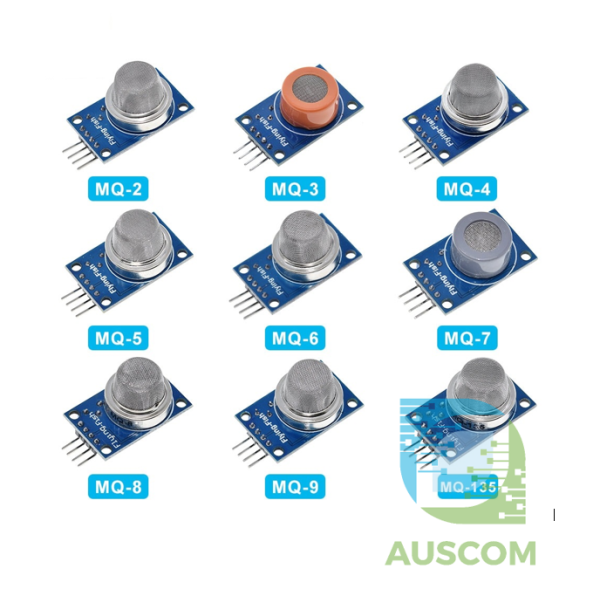
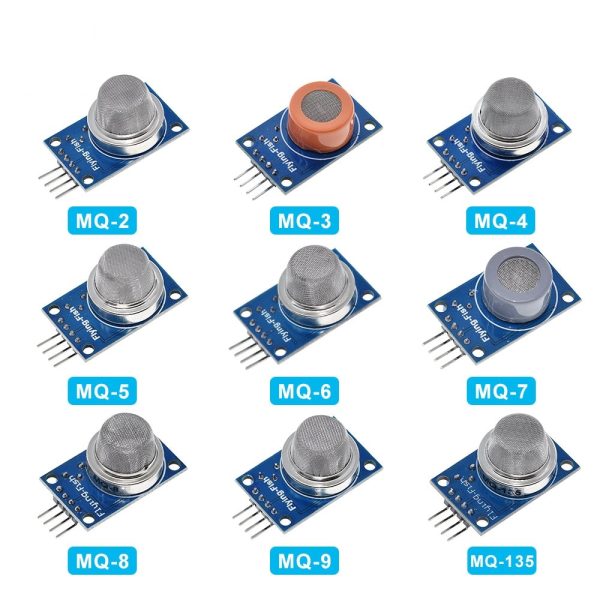
MQ Series Gas Sensor Module for Arduino – MQ-2, MQ-3, MQ-4, MQ-5, MQ-6, MQ-7, MQ-8, MQ-9, MQ-135 for Gas Detection

Price range: $6.95 through $9.95 Inc. GST
You save
- Description
- Code Examples
- Additional information
- Reviews (0)
Description
High-Performance MQ-Series Gas Sensor Modules for Arduino Projects
Enhance your Arduino projects with our premium selection of MQ-series gas sensor modules, designed for Arduino enthusiasts and electronic hobbyists. Our range includes the popular MQ-2, MQ-3, MQ-4, MQ-5, MQ-6, MQ-7, MQ-8, MQ-9, and MQ-135 gas sensors, each engineered for precise gas detection and accurate measurement in a variety of applications.
Key Features of MQ Gas Sensor Modules:
- Dual-panel design for enhanced reliability, with clear power indicator and TTL signal output instructions.
- Versatile integration with both digital (TTL) and analog output signals, ensuring compatibility with microcontrollers, Arduino boards, and relay modules.
- TTL output signal activates in a low state, providing direct connectivity options for projects.
- Analog output voltage fluctuates with gas concentration, offering accurate measurement for precise gas level monitoring.
- Easy mounting with four screw holes, making the sensor module simple to position.
- Exceptional durability and stability, built to last for extended use.
- Rapid response and recovery time, ideal for real-time gas monitoring.
- Features high-quality SnO2 (tin oxide) sensors for accurate detection of gases in clean air environments.
- Operating voltage: DC 5V; Power consumption: 150mA.
- Digital Output (DO): TTL 0 and 1 (0.1V and 5V).
- Analog Output (AO): 0.1-0.3V (correlates to pollution levels), with a max concentration of around 4V.
Important Note: Upon powering on, the sensor requires a 20-second warm-up period for accurate readings. The sensor may emit some heat during this process due to its internal heating wire. If the sensor becomes excessively hot, please inspect it for potential issues.
Tailored Gas Sensor Modules for Specific Applications:
- MQ-135 Gas Sensor: Ideal for monitoring home and industrial gas leaks, including gases like LPG, butane, propane, methane, smoke, ammonia, sulfide, and benzene.
- MQ-2 Gas Sensor: Perfect for detecting natural gas, hydrogen, butane, propane, methane, and smoke, making it excellent for home and factory gas leakage monitoring.
- MQ-3 Gas Sensor: Sensitive to alcohol vapors, resistant to interference from gasoline, smoke, and water vapor—ideal for breathalyzer and ethanol vapor detection applications.
- MQ-4 Gas Sensor: Highly sensitive to methane, propane, and butane—great for combustible gas leak detection in homes and factories.
- MQ-5 Gas Sensor: Detects LPG, natural gas, and coal gas with high sensitivity, ideal for home and industrial gas monitoring.
- MQ-6 Gas Sensor: Versatile for detecting propane, butane, LPG, and natural gas, ideal for various combustible gas detection needs.
- MQ-7 Gas Sensor: Best for carbon monoxide detection, with high-low temperature cycling for enhanced accuracy in home and industrial settings.
- MQ-8 Gas Sensor: Specially designed for hydrogen gas detection, suitable for home and industrial environments.
- MQ-9 Gas Sensor: Offers high-low temperature cycling for detecting carbon monoxide, methane, and LPG, making it a cost-effective solution for diverse gas monitoring applications.
Upgrade your Arduino-based gas detection systems with our reliable and accurate MQ-series sensors. Whether you’re working on gas leak monitoring, building a breathalyzer, or creating advanced industrial detection systems, our modules offer the precision, versatility, and dependability you need to succeed.
📌 Code Examples & Usage – MQ Series Gas Sensor Modules (MQ-2 / MQ-3 / MQ-4 / MQ-5 / MQ-6 / MQ-7 / MQ-8 / MQ-9 / MQ-135)
📋 Overview
The MQ series gas sensors are metal-oxide semiconductor (MOS) sensors used to detect various gases such as:
-
LPG / Propane / Butane
-
Methane / Natural gas
-
Hydrogen
-
Carbon monoxide (CO)
-
Alcohol / smoke
-
Air quality (MQ-135: CO₂ equivalent, NH₃, VOCs)
These modules include:
-
A heater element
-
An analog output (AO) for gas concentration
-
A digital output (DO) with adjustable threshold (via onboard potentiometer)
⚠ IMPORTANT – Warm-Up & Accuracy Notes (Very Important)
MQ sensors require warm-up time to function correctly:
-
Initial burn-in: 12–24 hours (first ever use)
-
Normal warm-up: 1–5 minutes after power-up
❗ These sensors are not laboratory-grade instruments.
They are best used for:
-
Gas presence detection
-
Relative changes / trends
-
Threshold alarms
Not for precise ppm measurement without calibration.
🔌 Typical Pinout (Most MQ Modules)
| Pin | Function |
|---|---|
| VCC | 5 V |
| GND | Ground |
| AO | Analog output (0–5 V) |
| DO | Digital output (HIGH/LOW threshold) |
✔ Heater typically draws 150–200 mA
✔ Use a stable 5 V supply (not weak USB power)
🧪 1️⃣ Arduino Example – Read Analog Gas Level
✔ Use this for relative gas concentration
✔ Higher value = more detected gas
🧪 2️⃣ Arduino Example – Digital Alarm Output
The digital output triggers when gas exceeds the set threshold.
📌 Adjust the onboard potentiometer to change trigger level
📌 Many modules use LOW = alarm active
🧪 3️⃣ ESP32 Example (Analog Read, 0–3.3 V)
ESP32 ADC inputs are 3.3 V max.
Most MQ modules output up to 5 V, so use a voltage divider on AO.
✔ Use a divider (e.g. 10k / 20k) to scale 5 V → 3.3 V
✔ Digital output (DO) is usually safe at 3.3 V logic
🧠 Sensor Selection Guide (Quick Reference)
| Sensor | Common Uses |
|---|---|
| MQ-2 | LPG, propane, hydrogen, smoke |
| MQ-3 | Alcohol / ethanol |
| MQ-4 | Methane / natural gas |
| MQ-5 | LPG / natural gas |
| MQ-6 | LPG / butane |
| MQ-7 | Carbon monoxide (CO) |
| MQ-8 | Hydrogen |
| MQ-9 | CO + flammable gas |
| MQ-135 | Air quality (CO₂ eq, NH₃, VOCs) |
🧠 Calibration & Practical Use
✔ Allow full warm-up before taking readings
✔ Use baseline readings in clean air
✔ Compare changes relative to baseline
✔ For alarms, use digital output
✔ For trends/logging, use analog output
⚡ Power & Noise Notes
-
Heater draws significant current — avoid powering from weak USB ports
-
If readings fluctuate:
-
Add bulk capacitor (470–1000 µF)
-
Keep sensor wires short
-
Use stable 5 V regulator
-
Additional information
| Weight | 40 g |
|---|---|
| Dimensions | 260 × 160 × 20 mm |
| Module Type | MQ-2, MQ-3, MQ-4, MQ-5, MQ-6, MQ-7, MQ-8, MQ-9, MQ-135 |
Only logged in customers who have purchased this product may leave a review.




Reviews
There are no reviews yet.